Resources
Frequently Asked Questions
Backflow Valves
Each home in the Park at Timberhill has a backflow valve on its sprinkler system, and the City of Corvallis requires that every backflow valve be professionally tested at least once a year. Starting in 2006, the Park at Timberhill Owners Association has contracted to have all Park at Timberhill valves tested (at a rate of $17 vs. the normal rate of around $40). The charge for this testing comes out of your semi-annual assessments. You do not need to take any action; if you have an open-ended testing contract for your backflow valve, you should cancel it.
The backflow valve is designed to prevent sprinkler water from returning to and contaminating the City water system if there’s a sudden drop in water pressure. It is located under a green cover in your front yard. (There are also ‘mini-backflow valves’ built into your outdoor water faucets; these do not require testing.)
Satellite Dishes
Trash, recycling, and glass pickup
Allied Waste picks up trash and recycling every Monday; all non-glass recycling goes into the new tan recycling carts. Please put the carts out only when they are full or getting heavy, to make the pickup process more efficient. (By default, you will get a 65-gal cart — about the size of a yard debris cart — UNLESS you request a smaller one — 32 gal or 45 gal. You may call Allied Waste at 754-0444 to request a smaller cart.)
Glass recycling goes into one of the old-style plastic bins. Glass will be picked up only on the first Monday each month:
Yard waste pickup is every other Monday: For exact start/end dates, call Allied Waste at 541-754-0444.
The PAT CC&Rs require that trash cans, recycling containers, and yard waste containers be stored out of public view, except for the night before and day of pickup. Containers left out on a chronic basis may result in a fine.
Washing Machine Hoses
Just a reminder to replace your washing machine water hoses at least every five years. This goes for both rubber and steel braid cables, and for both hot and cold hoses. If a hose breaks, there is nothing to stop all that water pouring into your house, so it’s very cheap insurance.
Winterizing Your Home
When cold weather comes, you should take certain steps to ensure that your pipes don’t freeze.
There are three parts to this process: draining your irrigation system, draining your faucets, and closing off foundation ventsDraining Your Irrigation System
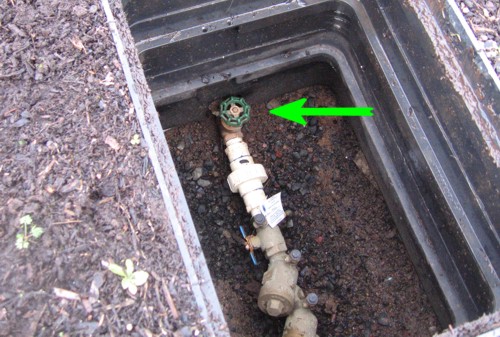
- Locate your irrigation valve. This is the rectangular green plastic cover shown in the picture below. It is probably in your front yard near the sidewalk, close to the water meter (the metal cover in the sidewalk).

- Remove the green cover. Just hook a finger in the small hole and lift the cover straight up.
- Shut off your irrigation water supply. Locate the faucet-like handle on the pipe, as shown in the picture below. Turn it fully counterclockwise. (Do NOT move any of the other valves or handles.)
- Put the cover back on.
- Turn your sprinklers on for 10 minutes or so per valve or station. This will allow water to drain out of your irrigation pipes, provided that they slope a little.
- In spring, turn the water back on and check for leaks (puddles on your lawn).
Draining Your Outside Faucets
- Locate your faucet shut-off valves. Every outside faucet will have its own shut-off valve, which looks like the one in the picture below. These are usually in the garage near the water heater and under bathroom or kitchen sinks.
- Close the valve. Rotate the lever clockwise until it is at right angles to the pipe, as shown in the picture below.
- Open the outside faucet. The water will surge out, and will then stop flowing. (If the water keeps flowing, you picked the wrong outside faucet for the shut-off valve you closed.) Leave the faucet open until the spring.
- Locate the brass drain nut on the shut-off valve. The nut will be under the valve body, as shown in the picture below.
- Place a bowl under the shut-off valve. The pipe still contains as much as two quarts of water, so choose a bowl or tray large enough to hold this amount.
- Remove the nut. Unscrew the brass nut by turning it counterclockwise; you should not need a wrench. The remaining water in the pipe will drain into the bowl.
- Reinstall the nut. (Make sure the rubber pad is still inside!) Tighten it firmly with your fingers.
- In the spring, reverse the procedure. Open the shut-off valve and watch for leaks at the brass nut; tighten it more if needed. Go outside and shut off the faucet, which will be flowing full-blast. Finally, go back inside and again check the brass nut for leaks.
Close Foundation Vents
In the event of extremely cold weather, you should close your foundation vents until the temperature rises again to normal winter levels. This will protect the pipes in your crawl space from freezing, but will also eliminate the ventilation that keeps moisture from building up (and hence, helps prevent mold and mildew). Close the vents only when necessary.

To close the vents, sweep any dirt, bark, or other debris from the opening, and then pivot the flap into a vertical position. When the weather improves, pivot the flap down to horizontal again.

Newsletters